
What a Smart Home Really Is
Most people first meet smart home technology through products.
A smart bulb. A camera. A smart plug. A door sensor.
That is understandable. Products are easy to market, easy to compare, and easy to buy. But it also creates the most common misunderstanding in the category: the idea that a smart home is simply a collection of smart devices.
It is not.
A smart home is not made smart by the number of connected things in it. It becomes smart when those things work together in a way that is reliable, understandable, and useful in everyday life. That requires more than hardware. It requires communication, logic, structure, and a setup that can support real people living real lives.
This is where many homes go wrong. People think they are building a smart home when they are really just collecting connected products. The result is often a home with too many apps, too little automation, and more friction than expected.
To understand what a smart home really is, it helps to replace gadget-thinking with system-thinking.
That does not mean turning the home into an enterprise project. It simply means seeing the home more clearly. A smart home is a small private system where information moves between devices, rules shape behaviour, infrastructure affects stability, and the result has to work for an entire household over time.
Once that mental model is in place, later topics like platforms, protocols, automation, security, documentation, and maintenance become much easier to understand.
A Smart Home Is a Small Private System
A useful way to understand a smart home is to look at its basic pattern.
When something happens in the home, another part of the system detects it, interprets what it means, and determines whether a response is needed. If the right conditions are met, the system then acts.
A door opens. A sensor reports it. A rule checks the time and the household state. A light turns on, a notification is sent, or nothing happens at all.
This is the basic shape of a smart home: inputs, decisions, and outcomes.
That pattern matters because it shows that a smart home is more than a set of products. Devices are only one part of the picture. They sit inside a wider structure that also includes communication, control, reliability, and the people who live with the result.
Seen this way, a smart home is a small private system built inside the home. Some parts sense what is happening. Some parts carry information. Some parts apply rules. Some parts perform actions. And all of it depends on an underlying setup that is stable enough to support daily life.
This is also why two homes with similar devices can feel completely different in practice. One may feel calm, useful, and almost invisible. Another may feel awkward, fragmented, and unreliable. The difference is often not the products themselves, but how well the surrounding system works as a whole.
Before getting into platforms, protocols, automation, or security, this is the key idea to understand: a smart home becomes useful only when its parts form a workable whole.
Five Truths Behind a Smart Home
1. An information system
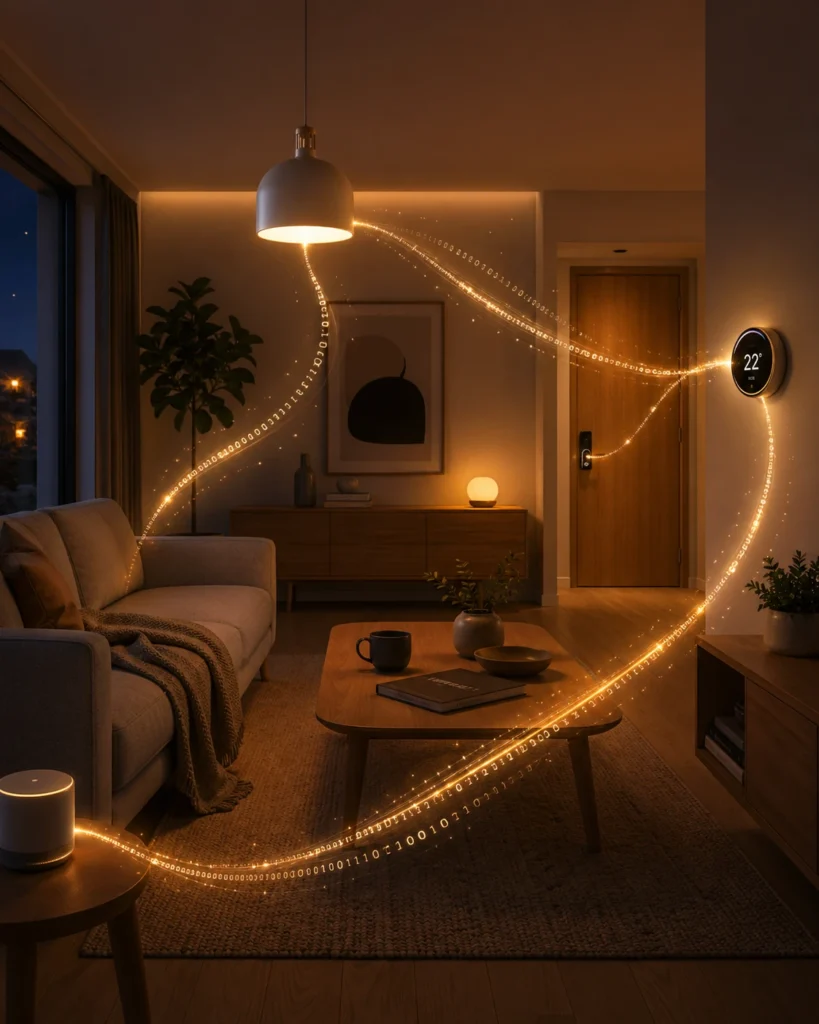
At its core, a smart home works by collecting, moving, and acting on information.
Sensors detect motion, temperature, humidity, light levels, door state, water leaks, energy use, and other changes in the environment. Buttons, schedules, and presence detection also create inputs. These inputs are data. They tell the home that something has happened.
Other parts of the system then respond. A bulb turns on. A plug turns off. A thermostat adjusts. A lock changes state. A notification is sent.
This is why smart home technology makes more sense when you think in signals and outcomes rather than gadgets. The devices are only the visible endpoints. The real value comes from the flow of information between them.
The practical meaning is simple: when information is missing, delayed, or misunderstood, the home behaves badly. When information flows well, the home behaves in a way that feels useful rather than random.
2. An ecosystem of dependencies
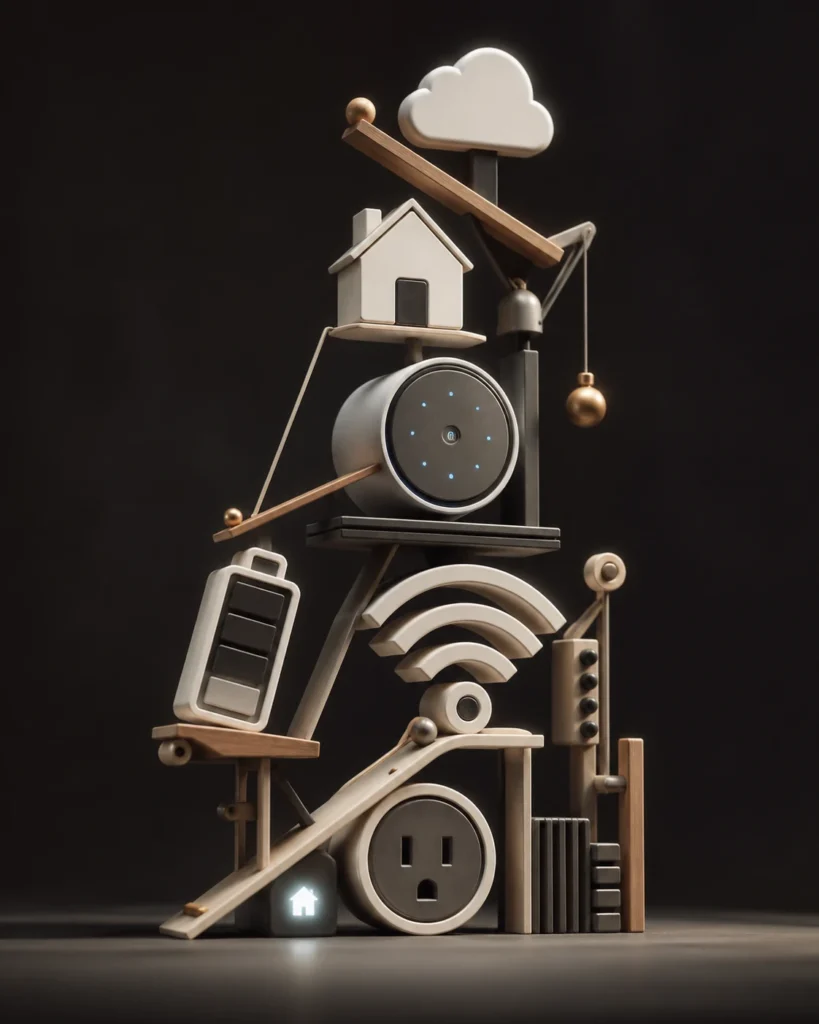
Smart home devices do not operate alone for very long.
A camera depends on power, connectivity, storage, and a way to view or manage what it records. A motion sensor depends on protocol coverage, battery health, and a rule somewhere that decides what to do with the event. A lock may depend on a hub, a phone ecosystem, a cloud service, and a reliable manual fallback when something goes wrong.
This is what dependency means in practice: one part of the system relies on another part to do its job properly.
That is why one weak link can affect the whole experience.
The quality of a smart home depends on several underlying conditions. Wi-Fi influences stability, protocols shape compatibility, hubs determine how well devices are coordinated, cloud dependence affects resilience, and power underpins everything else.
This is not a reason to make the home overly complicated. It is a reason to respect the fact that smart homes run on connected parts. The more clearly you understand those dependencies, the fewer unpleasant surprises you get later.
3. An experience, not a spec sheet
People in a home do not experience protocols. They experience outcomes.
What people notice is not the technology itself, but the outcome it produces: whether the hallway light turns on when it should, whether the front door locks reliably, whether the bedroom stays comfortable at night, and whether alerts are genuinely useful rather than a constant source of noise.
This matters because smart home decisions are often made from the wrong angle. Product pages push features. Real homes care about experience.
A device with an impressive list of functions is not automatically useful. A technically advanced setup is not automatically better. What matters is whether the home becomes easier to live in, not whether the system looks clever on paper.
This is also why household usability matters so much. A smart home succeeds when it feels natural, predictable, and low-friction. If people in the home need workarounds, open the wrong app, or guess what the system is doing, the experience is already starting to fail.
4. A process, not a finished project
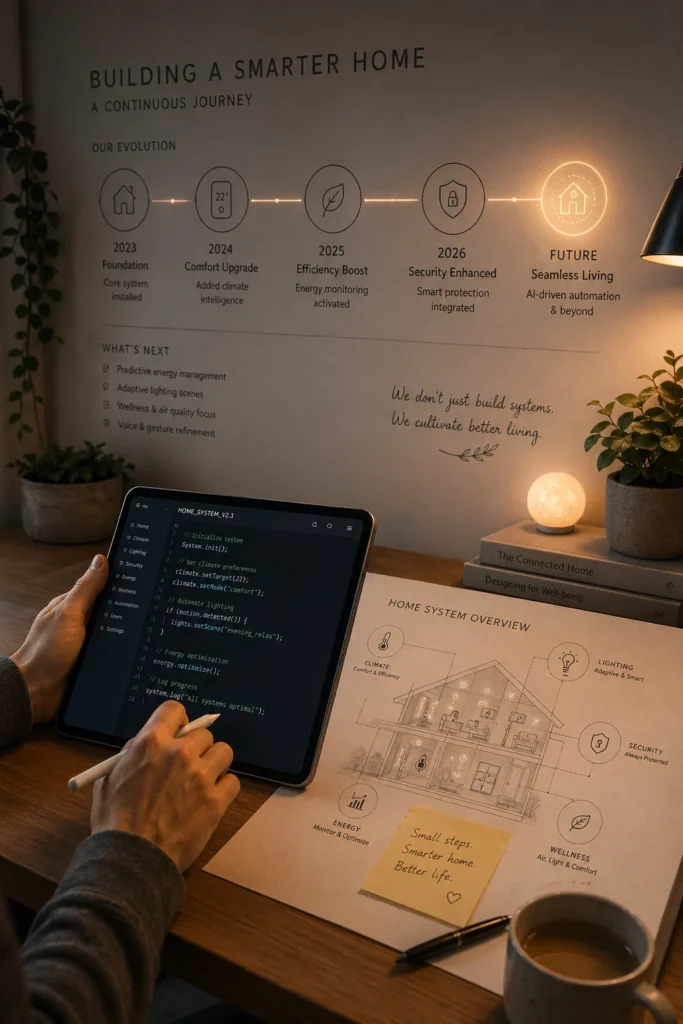
A smart home is never completely finished.
Devices get replaced. Batteries run low. Firmware changes. Platforms evolve. Automations need adjusting. Household routines change. Some solutions prove useful. Others need to be simplified, replaced, or retired.
That does not mean a smart home is unstable by definition. It means it has a lifecycle. It changes over time and needs to be managed accordingly.
This is where many people discover that installation is only the beginning. A working smart home also needs small amounts of review, adjustment, and maintenance. Not endlessly. Not obsessively. Just realistically.
The practical lesson is straightforward: build in a way that can survive change. Choose setups you can understand later. Document the essentials. Avoid fragile complexity. Expect to improve the home over time instead of trying to finish it in one weekend.
5. A family platform
A smart home is not just a personal hobby system. It is a shared household environment.
That changes the standard.
It is not enough that the builder understands it. Other people need to be able to use it too. Lights should still work in obvious ways. Doors should still be operable. Manual control should still exist where it matters. Notifications should make sense. The home should not become dependent on one person remembering how everything works.
This is where the Family CTO mindset begins. The goal is not to make the home more technical. The goal is to make it more useful, more robust, and more considerate of everyone who lives in it.
That means asking better questions. Can everyone use this? What happens when something fails? Is there a manual override? Would another adult understand the setup? Could the household keep going if the main builder were unavailable?
Those are not dramatic questions. They are practical ones. A home system should be resilient enough to support the household, not just impress the person who built it.

What Goes Wrong When People Think in Gadgets
Once people think of smart home technology mainly as devices, a predictable set of problems follows.
The result is usually predictable: products are bought one by one without a clear direction, platforms and protocols are mixed without much thought for the trade-offs, apps accumulate faster than useful automations, flashy features take priority over reliability, and the final setup often makes sense only to the person who installed it.
This is how homes become technically connected without becoming especially smart.
It also explains why app control is so often mistaken for intelligence. If the mental model is “smart home equals device,” then remote control feels like the obvious goal. But being able to turn a light on from your phone is not the same as having a home that behaves intelligently. It is only one level of capability, and often the lowest one.
The same problem appears in feature-driven buying. When gadgets become the centre of attention, architecture disappears. People buy what looks exciting or discounted rather than what fits the wider system. That may work for a while, but it usually produces a patchwork of tools rather than a useful household setup.
And once the home is treated as a collection of products, maintenance becomes an afterthought. There is no documentation, no clear view of dependencies, and no easy way to improve the setup over time. Problems feel random because the system was never really understood as a system in the first place.
A Better Way to Think About the Home
A better smart home starts with better framing.
A better approach is to start with needs rather than products, to consider how a new device will fit into existing relationships before buying it, to make small useful improvements instead of chasing big redesigns, to focus on household outcomes over technical novelty, and to think about maintenance and fallback from the beginning rather than only about installation.
This does not mean building a perfect model of the home before doing anything. It means starting with a better mental map. Once you have that, later decisions become easier to judge. You can better understand why protocols matter, why network quality matters, why platforms matter, why automation logic matters, and why documentation matters.
This is also where the home begins to look less like a gadget hobby and more like what it really is: a small household system that needs to support everyday life reliably over time.
That is the mindset behind Family CTO. Not more technology for its own sake, but better thinking about the technology that enters the home.
Key Takeaways
A smart home is not a collection of devices. It is a small private system.
Its visible parts are products, but its real value comes from how information, logic, infrastructure, and household needs work together.
That is why smart home technology should be understood as more than hardware. It is also communication, control, dependency, experience, and ongoing operation.
If you want to make better smart home decisions, start with the system rather than the gadget. Look at what the home needs to sense, decide, and do. Then judge products by how well they fit that bigger picture.
Once you adopt that mental model, the rest of the category becomes easier to understand. Platforms, protocols, automation, security, documentation, and maintenance stop looking like side topics and start looking like natural parts of the same whole.