
Smart home projects often fail for a surprising reason – not technology, but family acceptance. Here’s the rule every DIY smart home builder should understand.
The Dinner Table Test
The moment I decided to build my own home security system, the hardest part was not the technology.
It was introducing my family to the project at the dinner table.
This happened in the weeks after the break-in at our house – the event I described in The Wake-Up Call and later in Why I Chose DIY Home Security. The experience had left us all with the same uncomfortable feeling: Our home was unprotected.
After meeting with a couple of traditional alarm companies, I had quietly reached a conclusion.
I could probably build something better myself.
From a purely technical perspective, the idea didn’t feel outrageous. With an IT background and having spent most of my career in IT management, I’m the tech savey person in the family. In our household I am also the unofficial support department. I’m the one configuring the internet router, fixing laptops, resetting phones, adjusting TV settings, and replacing batteries in remote controls.
If a device in the house has a settings menu, chances are I’m the one who knows where it is.
So the technical challenge didn’t scare me.
But one thought kept coming back.
What if my project made everyday life harder for everyone else?
Because if there’s one thing I know about technology projects at home, it’s this: the technology itself is rarely the real challenge. The real challenge is the people who have to live with it.
That’s why the conversation at the dinner table mattered.
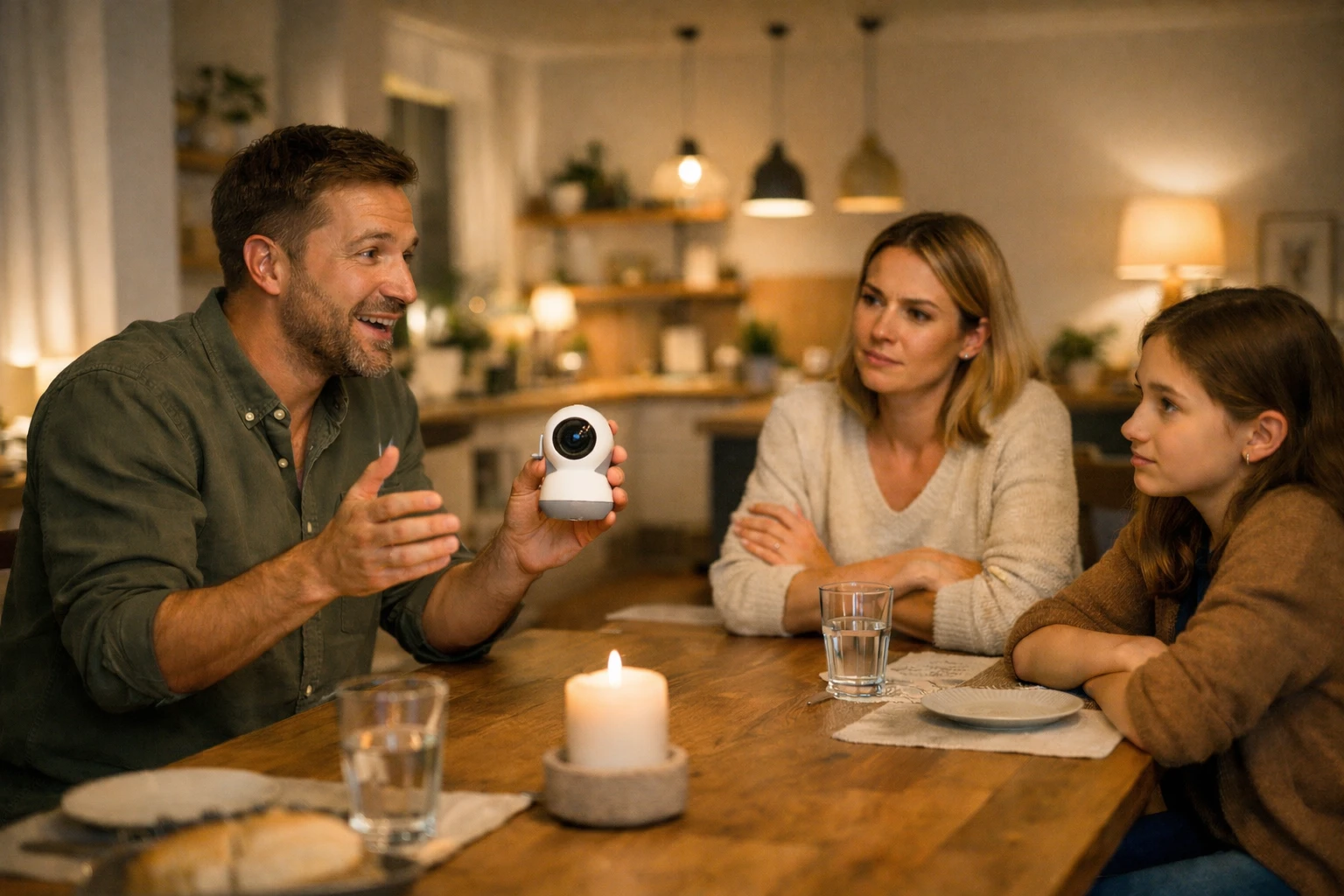
I explained the idea to my wife and daughters. Not the technical details, but the direction: instead of paying a monthly subscription to a security company, I wanted to build our own system.
To their credit, they listened. We had all experienced the same disappointing visits from alarm salespeople, so they understood the frustration.
Their reaction could best be described as polite indifference.
Polite indifference on the outside. Probably skepticism on the inside.
But they agreed.
Sometimes a family says yes not because they are convinced – but because they are kind.
And honestly, a “well… okay then” at the beginning is infinitely better than having to explain yourself afterwards.
WAF: The Wife Acceptance Factor
In the world of smart homes there’s a term that often shows up in forums and tech discussions.
WAF – Wife Acceptance Factor.
It’s usually mentioned as a half-serious joke among technology enthusiasts.
Looks cool. But what’s the WAF?
Behind the joke, however, is a very real truth.
Technology in a home doesn’t exist in isolation. It exists inside a family.
If a solution is confusing, unreliable, ugly, or constantly needs fixing, the people living with it will eventually push back. And rightly so.
These days the term has evolved into more inclusive versions like Partner Acceptance Factor or Family Acceptance Factor.
The meaning is the same.
A technology project only succeeds if the people in the house accept it.
What Acceptance Actually Means
Acceptance doesn’t come from impressive features.
It comes from simple things:
- Does it work every time?
- Does it make life easier?
- Does it look like it belongs in the house?
- Does it disappear into the background?
Most families don’t care about protocols, integrations, or automation logic.
They care about not having to reboot something before it works.
They care about not having cables hanging down the wall.
They care about not hearing the phrase: “Hold on, I just need to fix something.”
At least I do – especially during an important football match.
Selling a System That Didn’t Exist Yet
Convincing your family to accept a DIY security system presents a strange challenge.
You are asking them to trust something that:
- doesn’t exist yet
- cannot be tested
- cannot be touched
- and may or may not work
That’s not exactly an easy sales pitch.
So I made a deliberate choice.
I didn’t talk about technology.
I talked about problems.
First, the obvious one: the break-in had left all of us with the uncomfortable feeling that our home wasn’t as protected as we thought.
Second, visibility. Even simple things like warning signs and visible cameras can hopefully make a burglar think twice.
Third, the ability to check the security status of the house when we are away.
And finally, the economic argument.
A subscription alarm system means paying every month. Building our own system would cost money up front, but not indefinitely.
Those arguments resonated.
Not because they were technical – but because they were practical.
The discussion around the dinner table ended with cautious approval.
Fine. Go ahead and try.
Sometimes that is all the green light you need.
The Rule I Now Follow in Every Smart Home Project
Looking back, that dinner table conversation taught me something important.
A rule I now follow in every home technology project.
If your family can’t use your smart home project, it doesn’t matter how good your technology is.
A perfectly engineered system that frustrates everyone else in the house is not a success.
It’s a hobby.
And hobbies should not make everyday life harder for the people around you.
Practical Rules I Follow Today
Start small and evolve.
Talk about problems, not technology.
Finish what you start.
Prioritize reliability over features.
Give the family veto power.
If you’re reading this, there’s a good chance you are also the tech person in your household.
The one who knows the settings menus.
The one who fixes the Wi-Fi.
The one everyone calls when something beeps.
That role comes with responsibility.
Not just to build clever systems.
But to build systems that people actually want to live with.
The Lessons Learned
Smart home technology is often presented as a purely technical challenge.
In reality, it is something very different.
It is a family project.
Before installing sensors, hubs, cameras, or automation rules, the most important step happens somewhere much more ordinary.
Around the dinner table.
If your family understands the problem you are solving – and if the solution actually makes everyday life easier – then the technology has a chance to succeed.
If not, even the most elegant system will eventually be unplugged.
And that is WAF the smart home rule nobody talks about.