

In my previous article, The Rule Nobody Talks About, I wrote about the moment when my DIY smart home security project stopped being my project and quietly became our project.
If you have ever tried introducing new technology into a family home, you know exactly what that moment means.
Suddenly the stakes are higher.
What used to be a personal experiment now has to work in everyday life – for everyone.
And that changes everything.
Because now it is not just about curiosity. It is about reliability. Simplicity. And not breaking the household in the process.
In my case, it started with a simple idea: “I just want to make the house a bit safer.”
That sounded simple enough.
But like most things in tech, it did not stay simple for long.
From DIY Security to Something Bigger
The goal was clear: build a DIY security setup that could make the house a bit more aware of what is happening around it.
But it did not take long before I realised something important.
What I was building was not just a security solution.
It was part of something bigger – A smart home.
And a smart home, in turn, is part of an even bigger idea: devices connected through what is often called the Internet of Things – or IoT.
That is where things start to expand quickly.
Because once you step into that world, you are no longer just choosing a few devices.
You are suddenly navigating an entire ecosystem.
And that leads to a very practical question: Where do you even start?
Welcome to the Smart Home Jungle
Even if you are comfortable with technology, smart home systems can feel overwhelming at first.
I work with technology on a daily basis, so I am used to networks, routers and the usual technical alphabet soup.
But smart homes introduce a new layer on top of that.
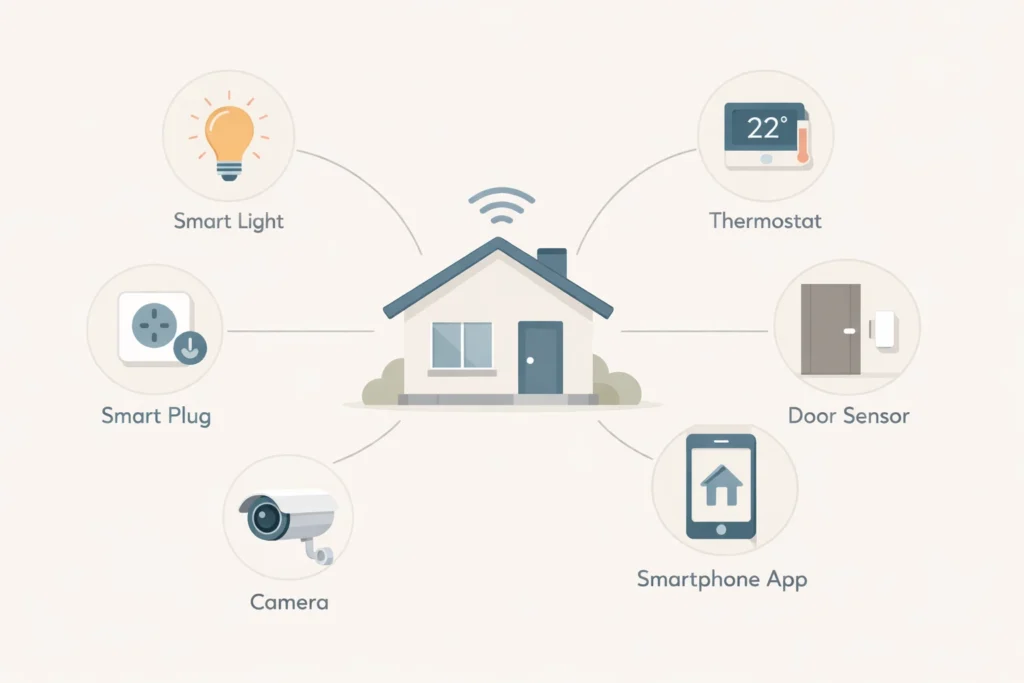
Suddenly you encounter terms like:
- Zigbee
- Z-Wave
- Thread
- Matter
- hubs
- ecosystems
- automations
It does not take much before it starts to feel like a jungle.
And on top of that, there are countless manufacturers – all claiming that their solution is the smartest, easiest and most future-proof.
You don’t need to understand the entire smart home universe before installing your first device.
In fact, trying to do so is often the fastest way to never start at all.
My Simple Rule: Learn a Little, Plan a Little, Start Small
Over time, I have seen the same mistake repeated again and again.
People start with:
- no real understanding
- no clear plan
- enormous ambitions
And then try to change everything at once.
That almost always ends badly.
Smart home projects are no different.
If you want your project to succeed, follow a much simpler strategy:
Learn a little. Plan a little. Start small.
First: Understand What a Smart Home Actually Is
Before diving into protocols and platforms, it helps to step back and understand the basic idea.
A smart home is simply a collection of devices that:
- can be controlled digitally
- can communicate with each other
- can react automatically to events
You might control them through an app, a hub or even a voice assistant.
It is not more complicated than that.
The technology behind it can vary – but the idea stays the same.
Second: Choose One Ecosystem to Start In
This is where many beginners get stuck.
There are multiple ecosystems, and each comes with its own strengths.
The most common ones include:
- Apple Home
- Google Home
- Amazon Alexa
A simple rule of thumb is:
Start with what you already use.
If you already have an iPhone, Apple Home is a natural place to begin.
If your home revolves around Google services, Google Home might be the easiest choice.
In my own project, I ended up choosing something different – but that is a story for another article.
Third: Only Learn the Minimum About Protocols
When you first look into smart home technology, you will quickly run into technical terms.
You do not need to master them all.
A simple understanding is more than enough:
- Wi-Fi = easiest to get started
- Zigbee / Thread = more stable, requires a hub
- Matter = promising, but still evolving
That is all you need to begin.
The rest will make sense once you start working with real devices.
Fourth: Start With One Small Project
This is where most people go wrong.
It is tempting to imagine the fully automated home from day one:
- lights that react instantly
- heating that adjusts itself
- doors that lock automatically
But trying to build everything at once quickly leads to frustration.
Instead, start with one small project or just a few devices.
For example:
- a single smart light
- a smart plug
- a door or window sensor
- a simple motion-based light
That first setup will teach you more than hours of reading ever could.
You will understand:
- how devices are added
- how apps work
- how automations are created
It is like learning to ride a bike.
You do not learn it by reading – you learn it by doing.
The Classic Beginner Mistake
The biggest mistake is surprisingly consistent.
Trying to do too much, too fast.
Starting without a plan.
Trying to understand everything upfront.
Aiming to automate the entire house from day one.
That combination rarely ends well.
A better approach is to build your system step by step.
Start small.
Learn from each step.
Expand when it makes sense.
That way, your smart home grows with you – instead of working against you.
Your Takeaway
Starting a smart home project can feel overwhelming.
There are new concepts, unfamiliar technologies and more options than anyone realistically needs.
But you do not need to understand everything before you begin.
The most reliable path to success is simple:
Learn a little. Plan a little. Start small.
Start with a small project or just a few devices.
Build confidence through experience.
And expand from there.
Because once you have taken that first step, the rest of the journey becomes far less complicated – and a lot more rewarding.
One response to “Start Small or Fail Big”
[…] I did one thing right. I started small. One camera. One sensor. Get something working before opening every box in the shipment and killing my return options. That […]