
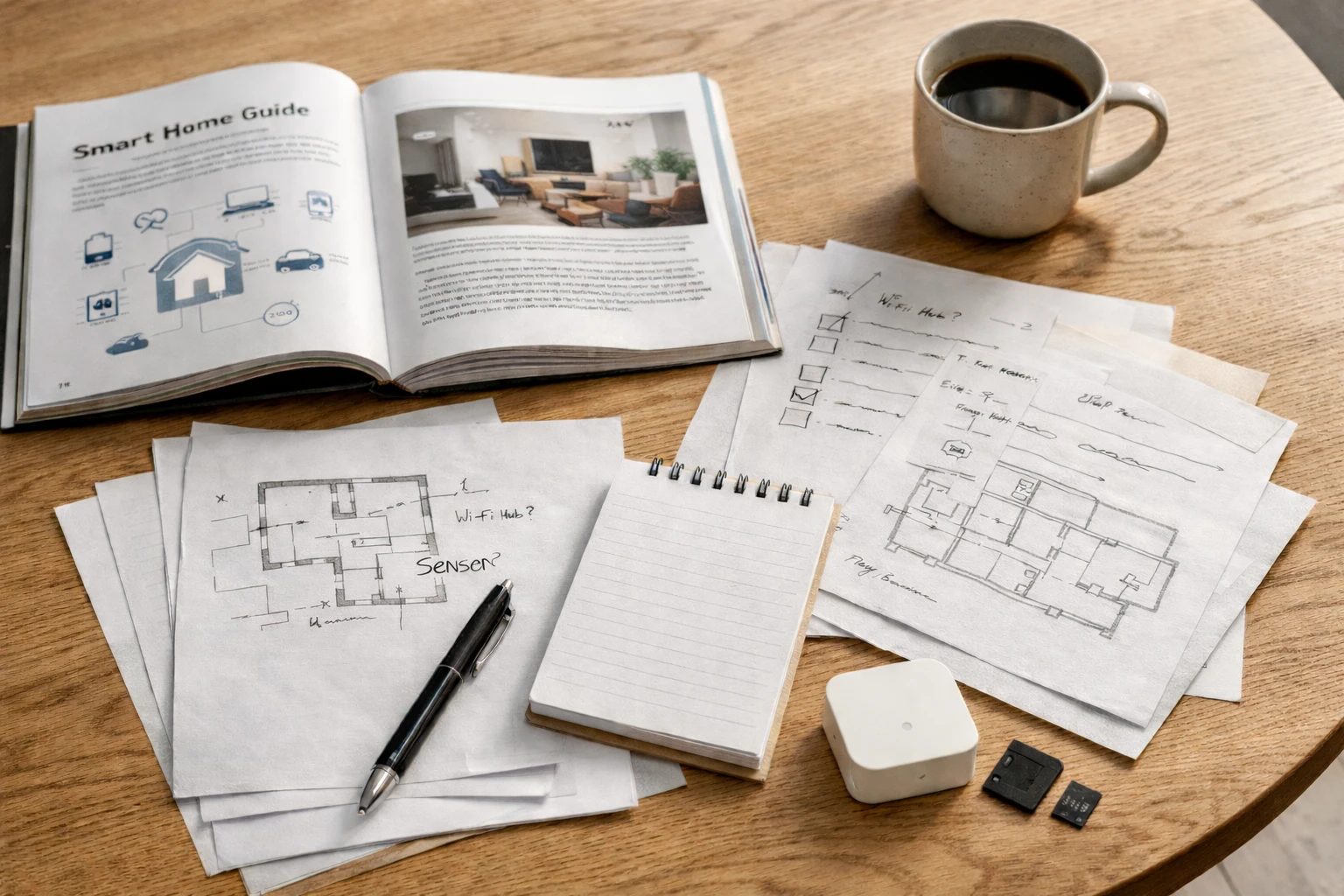
A smart home rarely turns chaotic in one dramatic moment. It happens device by device, automation by automation, until one person is quietly running a small IT ecosystem from inside the family home. This article explores why that happens, why the market does not really help, and what a lightweight Family CTO method could change.
Why DIY Smart Homes Need a Method
My thoughts about use cases, needs, requirements, and trade-offs did not begin the day I sat down to name them properly. They had been rattling around in the back of my head ever since I decided to build my own alarm system for our family home.
At the time, I did what many of us do. I bought some gear, called it a proof of concept, and told myself I was being disciplined.
In my case, “a little gear” turned into som Aqara equipment – specifically three Aqara Camera Hub G3 units, three SanDisk Extreme 128GB microSD cards for local storage, and seven Aqara Door and Window Sensor T1 units. Total cost: 2,176.80 DKK, or roughly €291 / $343 at 2026 reference rates.
Still, I did one thing right. I started small. One camera. One sensor. Get something working before opening every box in the shipment and killing my return options. That part, at least, was sensible.
What I did not do was approach the project in a fully structured way.
That does not mean I was careless. Quite the opposite. I thought about all the things that matter when you put security tech into a real home with real people inside it.
Where should the cameras go? Indoors or outdoors? Should they run on batteries or fixed power? Could I store video locally? How easy would it be for a burglar to disable the cameras? What would indoor cameras do to the family’s sense of privacy? How much did looks matter?
That last one, by the way, was not a minor detail. In our home, aesthetic acceptability is not a soft preference. It is closer to a hard requirement with immediate executive oversight.
I also thought about integrations, vendor lock-in, reliability, and future flexibility. So the problem was never a lack of reflection. The problem was that all those reflections lived in my head, as loose thoughts rather than something I had turned into a method.
And that, I think, is where many smart home projects quietly go off-script.
Most DIY Smart Homes Are Not Designed. They Accrete.
A lot of DIY smart home systems do not arrive through architecture. They arrive through accumulation.
One device solves a problem. Then another adds convenience. Then an automation removes one small daily annoyance. Then a hub, a sensor, a rule, a workaround, a cloud dependency, and a half-remembered setting from last November quietly move in and never leave.
At first, this feels efficient. You are solving real problems. You are learning as you go. You are improving the home one practical step at a time.
And to be fair, that is often how good projects begin.
But incremental growth has a hidden cost. Over time, your home stops being a collection of gadgets and starts becoming a distributed IT ecosystem: devices, services, automations, data flows, wireless dependencies, and operational assumptions, all stitched together into something that now affects security, comfort, privacy, and everyday life.
That is a bigger thing than “I bought a few sensors.”
The strange part is that this transformation often happens without anyone formally noticing. One person in the house gradually becomes the person who knows how it all works. Usually because they are curious. Usually because they enjoy it. Usually because they are capable.
That is how the Family CTO role appears: not through appointment, but through drift.
The trouble is that drift makes for a very poor operating model.
In many homes, the logic of the system lives almost entirely in one person’s head. They know why the hallway light behaves differently after 11 p.m. They know which camera is on local storage and which one quietly depends on a cloud setting buried three menus deep. They know which device occasionally falls off the network and needs a small ritual rather than a reboot.
Everyone else just knows that “Dad has done something with the house.”
That is not shared ownership. That is a single point of human failure.
“Who makes sure this still works if I step in front of a truck?”
It is a dramatic question, yes. Slightly dark. Not ideal dinner conversation. But it is also the right question.
Because once your smart home reaches a certain level of complexity, resilience is no longer just about batteries, backup power, or wireless range. It is also about whether the system can survive the temporary or permanent absence of the person who built it.
And that is where the technical problem turns into a social one.
In my own home, I think the family viewed the project with healthy skepticism from a polite distance. Not hostility. More the affectionate kind of skepticism reserved for hobbies that look suspiciously like work.
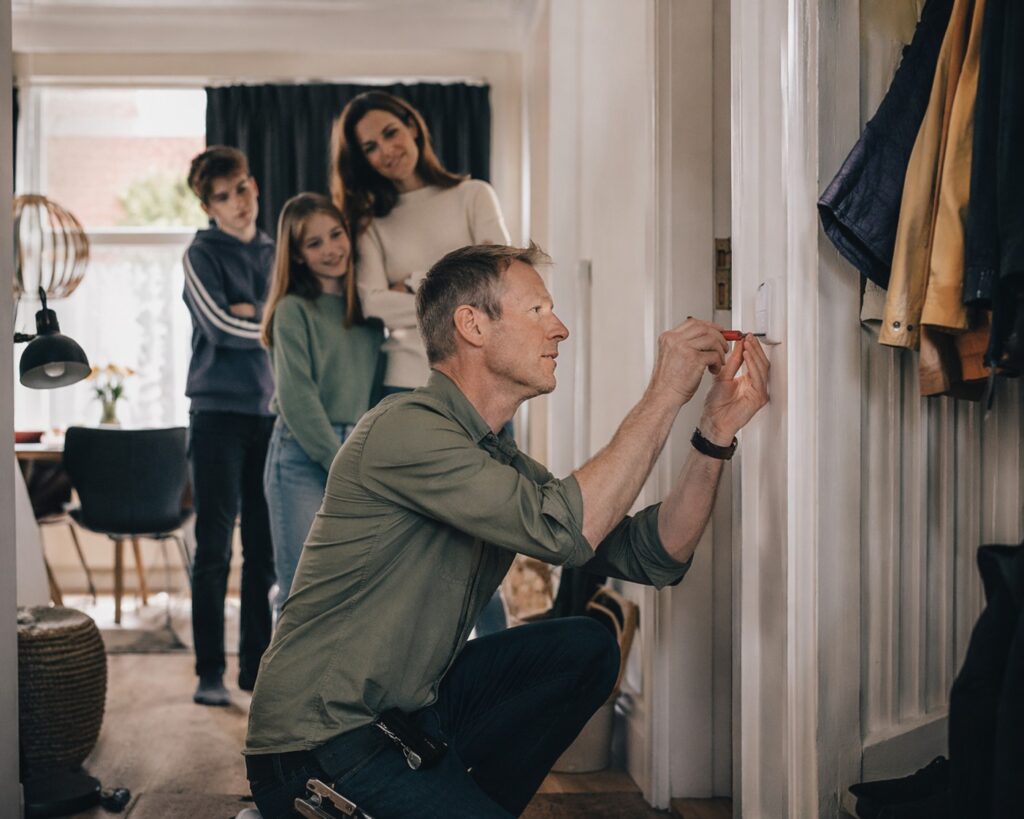
I am sure part of their thinking was something like this: This clearly makes Dad happy, which may be the main deliverable here. But I also think they trusted that I would eventually make it work.
The catch is that trust is not the same as ownership.
For quite a while, it remained “Dad’s project” more than a shared household capability, even though we had already agreed around the dinner table that smarter home security made sense for all of us.
That gap matters more than most smart home discussions admit.
The Market Is Great at Selling Devices and Weirdly Bad at Selling Method
The modern smart home market gives us many things: shiny products, big promises, attractive dashboards, and enough acronyms to make a grown adult miss the simplicity of a dumb light switch.
What it does not give most households is a practical method.
Yes, standards and protocols matter. Matter, Zigbee, and Z-Wave all exist to improve interoperability and help smart devices work together across ecosystems or within shared wireless solutions.
But they do not tell you how to define a use case.
They do not help you negotiate household boundaries around privacy.
They do not help you decide what must work offline, what can tolerate delay, what needs a manual fallback, or how to document the system so another adult in the house can take over basic operations.
Matter can help devices talk. It cannot run a family meeting.
Zigbee can connect objects in a mesh network. It cannot explain to your spouse why the indoor camera is a good idea if the trade-off feels creepy.
Z-Wave can support smart home systems across brands. It cannot decide whether your alarm design is robust, understandable, or socially acceptable.
That is not a criticism of the standards themselves. They are solving technical interoperability, not household governance. That distinction matters. The gap I am describing is my own conclusion from what these standards are built to do and how they present themselves.
And it is not just the standards. Most consumer platforms quietly assume a single administrator model. One account. One person in charge. One digital adult at the controls.
That may be fine for a toy setup. It is less fine for a family home where technology affects daily routines, safety, and trust.
In professional environments, systems come with some version of requirements, risk thinking, documentation, architecture, roles, and handover. At home, the same kinds of dependencies often exist, but the tools and habits do not.
So the DIY smart home world ends up in an awkward middle ground. It is too complex to treat casually, but too consumerised to come with serious structure.
That is the methodological hole I kept running into.
What the IT World Taught Me Without Turning My Home Into a Corporate Workshop
This was the point where my experience from the IT world started nudging me in the ribs.
Not because I wanted to import heavyweight frameworks into the house. No family needs sprint planning for motion sensors. No one wants a governance model for bedside lamps. And if I ever propose a formal steering committee for hallway lighting, I deserve to have my admin rights reviewed.
But professional methods do contain useful habits.
The best ones force you to clarify why before you obsess over how.
They make requirements visible.
They separate must-haves from nice-to-haves.
They encourage risk thinking.
They assume that systems should be understandable by more than one person.
Most importantly, they leave traces. Notes. diagrams. decisions. assumptions. Something more durable than memory.
Looking back, I can see that many of my early smart home thoughts were already requirements in disguise.
The camera placement question was a requirement question.
The privacy concern was a requirement question.
The “can a burglar easily disable this?” question was a resilience question.
The design concern was absolutely a requirement question, whether a traditional engineer would admit it or not.
The lock-in concern was an architecture question.
I just had not translated them into a simple, reusable structure.
That translation is the real shift.
Once you do it, you stop treating the smart home as a pile of gadgets and start treating it as a system that deserves a little design discipline. Not a lot. Just enough.
Enough to make better decisions.
Enough to avoid silly purchases.
Enough to make trade-offs explicit.
Enough to reduce the risk that your home becomes a magical black box maintained by one slightly overcommitted enthusiast with a screwdriver and a good memory.
The Family CTO Method Starts With a Few Very Unsexy Questions
The more I worked through my own proof of concept, the clearer it became that what DIY smart homes lack is not enthusiasm. We have plenty of that. What they lack is a lightweight method that ordinary households can actually use.
Not a binder full of process diagrams.
Not a 90-page implementation framework.
Not something that gets downloaded, admired, and never opened again.
I mean something small, practical, and alive. A method designed to be used in the middle of real life.
That is the thinking behind what I would call a Family CTO approach.
At its core, it is very simple.
Start with the home you want, not the devices you want to buy.
Capture a handful of use cases in plain language.
Make requirements visible.
Think about risk and fallback before something fails.
Document just enough that another person can understand the basics.
That is it.
Or at least, that is the beginning of it.
The specific tools can stay lightweight too. In fact, they should. The goal is not to imitate enterprise IT. The goal is to borrow just enough from it to make a home system more robust, more legible, and more shared.
In practice, that points toward a handful of useful artefacts:
The artefacts I wish I had started with
A Smart Home Handbook: a simple guide to what is installed, how it connects, and what to do when something stops working.
A Use Case Canvas: one page that turns vague wishes into concrete household outcomes.
A Capability Map: a way of seeing what the home actually needs to be able to do, independent of any one brand or device.
A Backlog and Roadmap: a place to prioritise improvements instead of buying whatever happens to be on sale this weekend.
A Tiny Risk Register: not because your home is a data centre, but because critical functions deserve manual fallback and a little foresight.
I am not unpacking all of those here. They deserve their own releases, and I plan to do exactly that.
But the larger point is already clear: once your home crosses from isolated gadgets into interconnected behaviour, the conversation has to grow up a little too.
Not into bureaucracy.
Into clarity.
Chaos vs. Structure Key Learnings
The smart home is often presented as a consumer category. Buy a few devices. Connect a few services. Enjoy the convenience.
That story is incomplete.
A modern smart home can easily become a small, distributed IT ecosystem inside the family home. And once that happens, the important questions are no longer only technical. They become operational, social, and even ethical.
Who benefits?
Who understands it?
Who controls it?
Who can fix it?
Who is comfortable with the trade-offs?
For me, that has become the real lesson.
The difference between a clever setup and a good home system is not the number of devices. It is whether the technology supports everyday life without creating confusion, dependency, or quiet resentment.
That is the gap the Family CTO idea is trying to close.
Not by making the home more complicated.
By making it more intentional.