
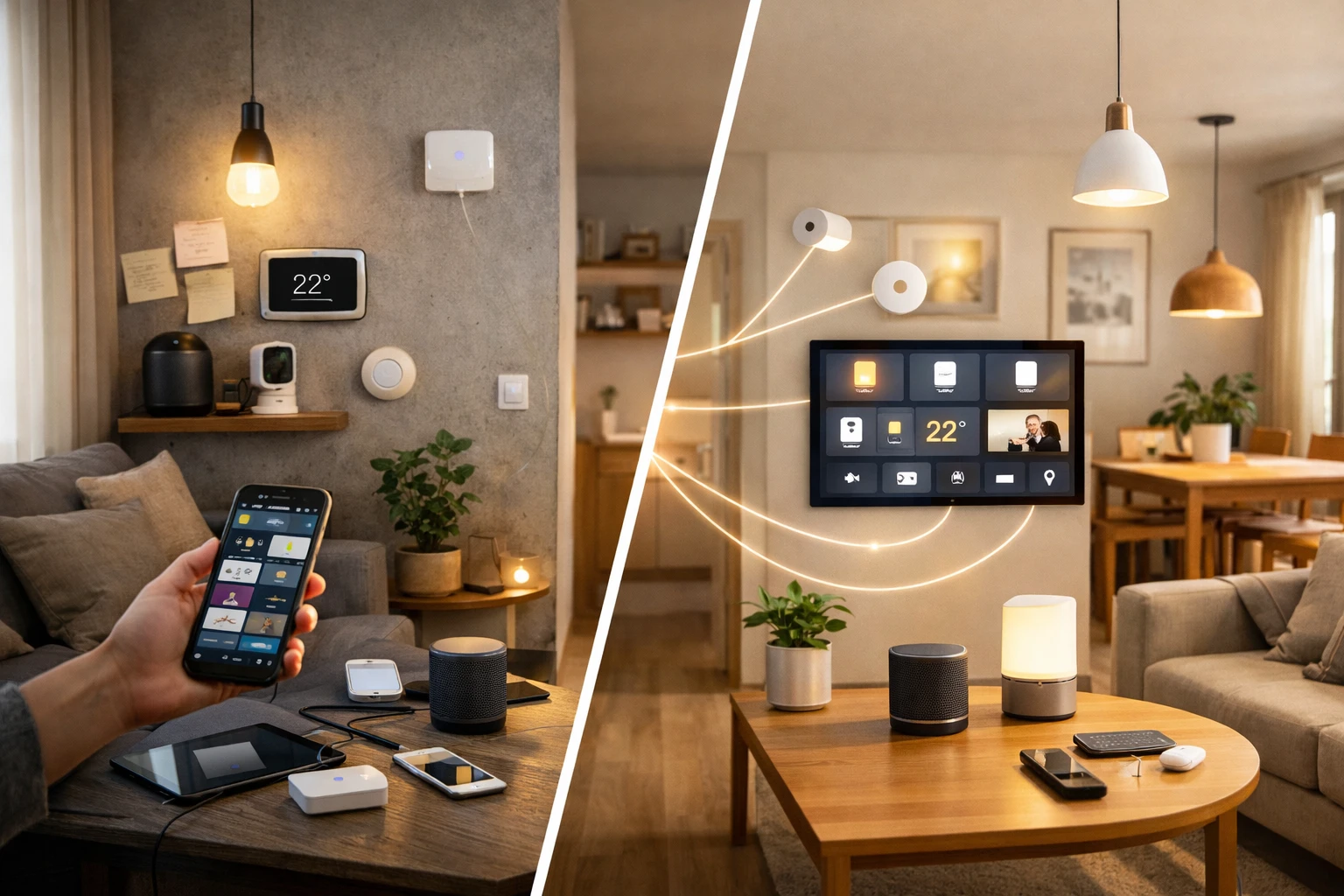
If you keep seeing the word Matter but are not quite sure why it matters, this article about how Matter works is for you. Here is what Matter actually is, why it was created, and how it could make smart homes more interoperable, and easier to live with.
The Word You Keep Seeing
In my article Zigbee Demystified, I wrote about that slightly awkward feeling smart home research gives you in the beginning: the sense that you thought you were shopping for products, but somehow ended up learning a new language instead.
That is still exactly the feeling.
The only difference is that now there is another word everywhere: Matter.
You see it on product boxes. You hear it in YouTube videos. It turns up in articles, store descriptions, and those cheerful “smart home explained in five minutes” videos that usually suggest the subject will take quite a bit longer than that.
At first glance, it is tempting to file Matter under another smart home buzzword and move on with your day.
That would be a mistake.
Matter is not just branding with good lighting. It is an attempt to solve one of the biggest long-term problems in smart home technology: devices that are smart on their own, but not especially smart together.
And honestly, that is a problem worth solving.
Because for years, smart home has not mainly suffered from a lack of clever gadgets. It has suffered from too many gadgets arriving with their own language, their own habits, and their own ideas about who they are willing to cooperate with.
Not a New Radio
The most useful way to understand Matter is this:
Matter is a shared smart home language.
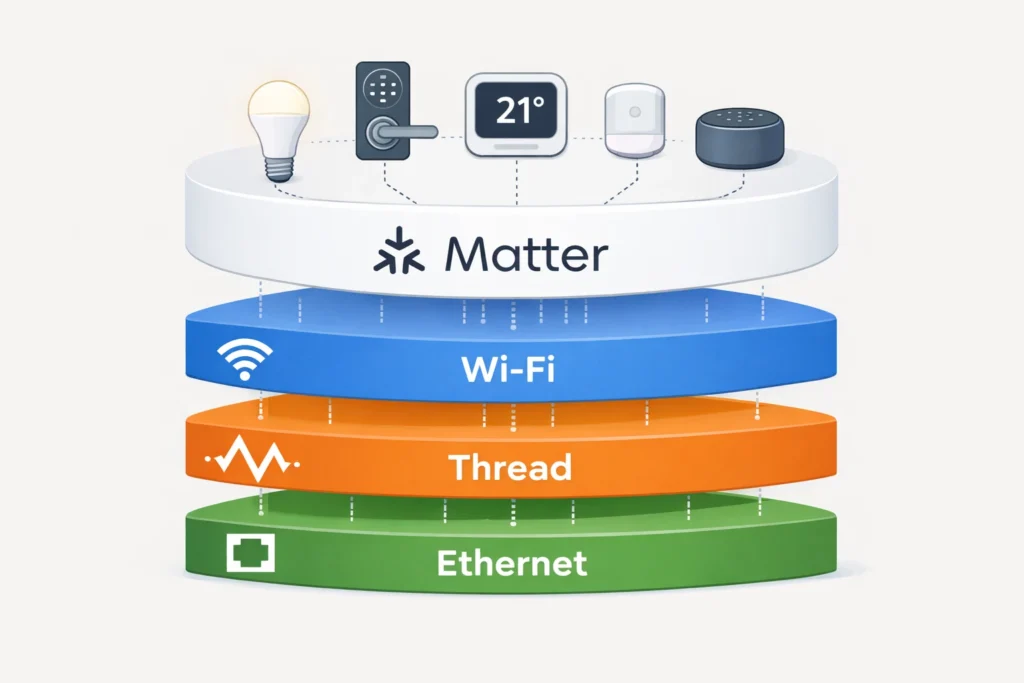
Technically, it is an application-layer standard. In normal-human terms, that means it defines a common way for smart home devices to describe themselves, expose their functions, and communicate so different ecosystems have a better chance of understanding them.
That last part matters more than it sounds.
Because Matter is not a radio technology in itself.
It is not the new Zigbee. It is not upgraded Wi-Fi. It is not some mysterious fifth thing that replaces everything that came before.
It sits on top of existing network technologies and gives them a more consistent way to communicate.
So if Zigbee is like bees communicating through a specific dance, Matter is more like everyone agreeing on a common alphabet. The route may still differ. The transport may still differ. But at least the message has a better chance of making sense when it arrives.
That is why Matter can work across different underlying technologies. A low-power sensor may use Thread. A larger device may use Wi-Fi or Ethernet. Bluetooth helps during setup. The transport layer changes depending on the device, but the goal above it is the same: more consistent communication and fewer translation problems.
Why This Had to Happen
Matter did not appear because the world was crying out for one more standard.
It appeared because smart homes had become a little absurd.
For a long time, the industry had a habit of producing devices that were individually clever and collectively awkward. One brand wanted you in its app. Another wanted you in its hub. A third wanted you in its cloud. A fourth was technically compatible with something, but only after enough account creation, firmware updates, and emotional compromise to qualify as a minor life event.
The result was what a lot of people accidentally built: smart home islands.
A camera over here. A thermostat over there. A few sensors in one app.
Some bulbs in another. And a growing sense that the “smart” part had perhaps been distributed somewhat unevenly.
That is not just annoying. It is a structural problem.
Because the real value of a smart home is not that you own several smart things. It is that those things can become part of a useful system.
That is where interoperability matters.
If devices cannot work together reliably, then what you have is not really a solution. It is a collection.
And if you care about security, resilience, or practical everyday automation, local control matters too. A system that can still do useful work inside the house without depending on the internet is simply more robust than one that falls apart the moment your connection has a bad day.
That does not mean every Matter product suddenly becomes perfect the moment it joins your home.
It does mean the architecture is moving in a healthier direction.
And there is also the less technical, but no less important, family angle.
If WAF (The Wife Acceptance Factor that I wrote about in this article) is already under pressure because you have decided to automate parts of the house, it does not help if the practical result is five apps, three partial integrations, and one partner politely asking why turning on a light now requires a systems diagram.
There are many ways to lose momentum in a smart home project.
“As it turns out, the door sensors only talk to one app, the lock only talks to another, and the rest of it needs a bridge I forgot to mention” is certainly one of them.
How Matter Works in Practice
This is the slightly nerdier part, but it is also where Matter starts to make practical sense – How Matter Works.
You do not need every technical detail.
You just need a rough map of the system.
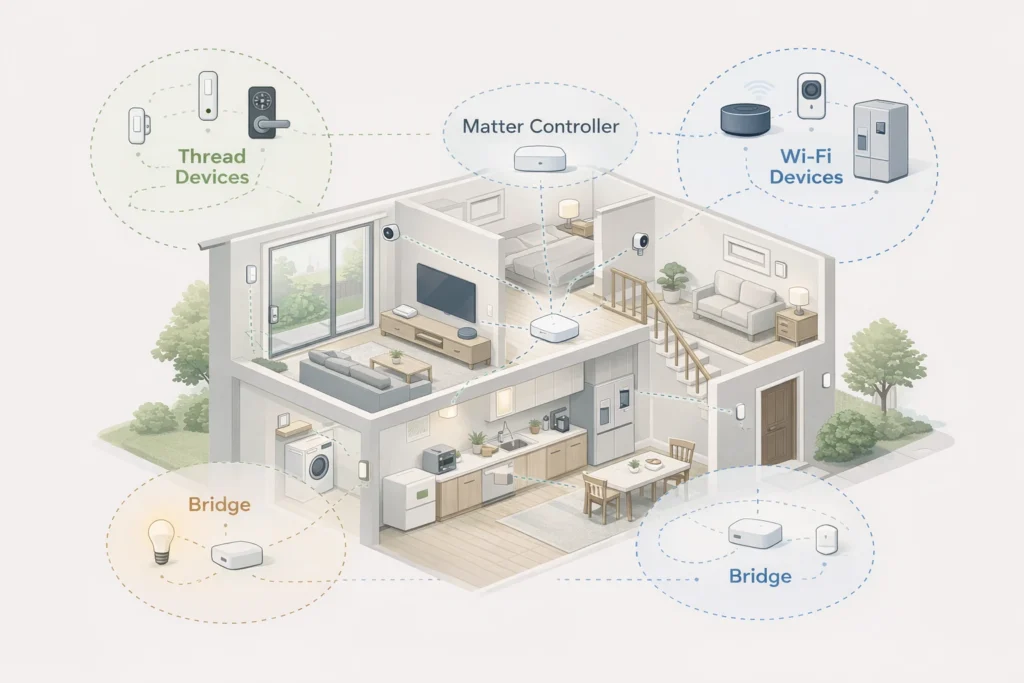
At the center is the Matter Controller. That is the platform, hub, speaker, or app that brings a device into your smart home and gives it a place in the setup. It is the part that says, more or less, “I know what you are, and I know where you belong.”
Behind that sits the Matter Fabric, which sounds more mysterious than it needs to. In simple terms, it is the trusted and secure relationship that lets devices and controllers communicate safely. The important point is not the name. The important point is that Matter was designed to create structured, secure cooperation rather than the usual smart home version of “everyone just try your best.”
Underneath that, Matter uses different kinds of transport depending on the device. Small, low-power devices will often rely on Thread, while devices with higher bandwidth needs may use Wi-Fi or Ethernet instead. Matter does not replace those network types. It gives them a more consistent way to work together.
And then there is the part that makes normal households breathe a little easier: bridges.
Because Matter is not based on the fantasy that everyone lives in an empty house and is delighted to start over. Bridges allow existing devices and older technologies to come along for the ride, which changes the practical question from “Do I need to replace everything?” to “How much of what I already own can still be part of the system?”
Old Gear, New Rules
Matter makes more sense when you stop asking whether it will replace everything and start asking what it changes.
What it changes is not the existence of older technologies. It changes how locked-in those older choices have to feel.
Zigbee does not suddenly disappear. Wi-Fi does not become irrelevant. Thread becomes more important. And plenty of existing devices will still live on through bridges, hubs, and mixed setups.
That is the real shift.
Matter is not here to erase the past. It is here to make the past less expensive.
Because for most people, the goal is not to rebuild an entire home from scratch every time the industry discovers a new favorite word. The goal is to end up with a system that can evolve without making every earlier decision feel like a permanent mistake.
And that is a much more useful ambition.
Most people are not trying to win a standards debate. They are trying to build a home where lights, sensors, locks, and automations can work together without turning every new device into a small compatibility investigation.
What Really Matters
You do not need to understand everything about Matter before you begin.
You do not need to memorize every acronym.
You do not need to become the kind of person who casually says “application layer” at dinner and assumes this will improve the atmosphere.
What you do need is enough understanding to make better decisions.
Enough to see why Matter exists.
Enough to understand the problem it is trying to solve.
Enough to recognize that interoperability and local control are not tiny technical footnotes, but part of whether a smart home becomes useful, resilient, and realistic to live with.
Matter does not solve everything.
It does not make every product equally good.
It does not remove complexity from the world by sheer force of branding.
And it definitely does not guarantee that all smart home companies have suddenly discovered humility.
But it does move the industry in a better direction.
And that matters.
Because the goal is not to understand everything before you start.
The goal is to understand enough that your next step is a good one.
In my next article, I will move from the theory to the practical side of the story: what Matter actually changes when you start buying devices, setting them up, and trying to make them behave like one system instead of five separate opinions.
One response to “Why Matter Matters”
[…] standards and protocols matter. Matter, Zigbee, and Z-Wave all exist to improve interoperability and help smart devices work together […]