
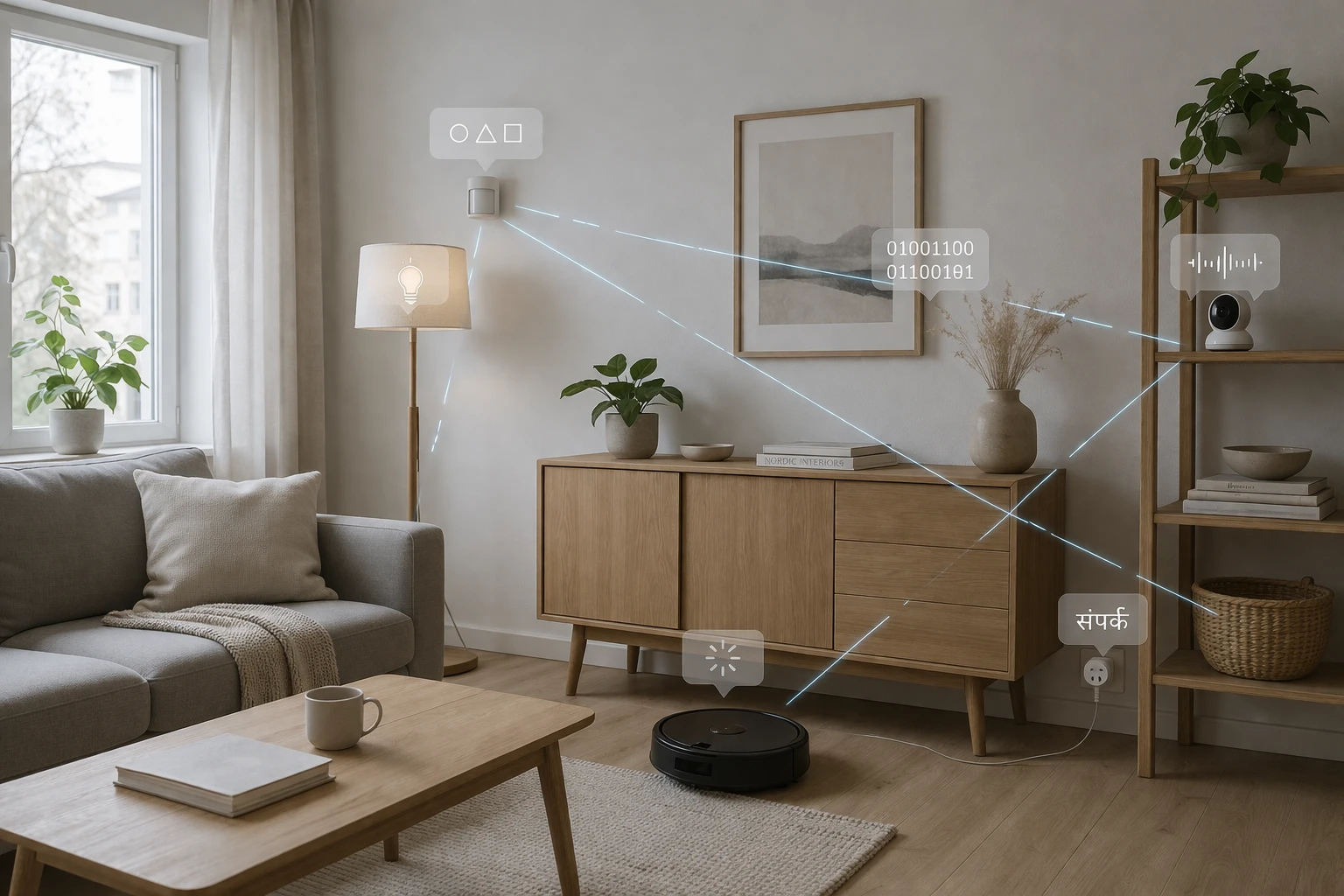
Smart home doesn’t have to be complicated. In this article, you’ll learn how devices communicate using simple, real-world examples. No technical deep dive – just enough understanding to get started and avoid common frustrations when your devices don’t seem to “talk” to each other.
From “My Project” to “Our Project”
In my earlier articles The Rule Nobody Talks About and Start Small or Fail Big, I talked about how you get your family on board – how your project goes from “my project” to “our project.”
And that’s usually the moment things get real.
Maybe you already have a basic setup running. Maybe you’re standing at the starting line, staring up at what looks like a steep learning curve filled with strange words and unfamiliar concepts.
Either way, here’s the only advice you really need right now: You don’t need to know everything – just enough to move forward.
Because the truth is, once you start building a smart home, you can’t completely avoid the technical terms. But here’s the good news: you don’t need to master them. You just need to understand them well enough.
Learn a little, plan a little, and start small.
If you’ve ever connected your phone or laptop to Wi-Fi, you’ve already proven that you can do this. And trust me – you can! This is just the next step.
The Mother-in-Law Test
Let’s make this practical.
Imagine you’re sitting at your mother-in-law’s house on a quiet Sunday afternoon. Coffee is poured. Cake is served. Everything is calm – until she points at her setup.

“My motion sensor works,” she says. “And the camera works. But they don’t seem to work together.”
You sigh. She sighs. You both know where this is heading.
If you can’t explain what’s going on, you’ll end up reinstalling her entire setup for the third time.
If you can explain it simply, you understand it enough.
This is your moment.
Because here’s the real goal: If you can explain it to your mother-in-law, you understand it well enough.
Not perfectly. Not technically. Just enough to make sense.
And that’s exactly where we’re going.
Your Home Is a Tiny Society
The easiest way to understand smart home technology is to stop thinking about technology.
Instead, think of your home as a small society.
Your security cameras, all your different sensors, all that smart lighting you bought because it could glow in millions of colors and blink in fancy sequences, your robot vacuum, maybe even your washing machine and your fridge, your “insert any kind of smart accessory” in your possession – they’re all just residents living under the same roof.
The problem?
They don’t all speak the same language and that’s where protocols come in.
Smart home problems are rarely about devices – they’re about communication.
Protocols are simply the shared languages and rules that devices use to communicate.
Think of it like trying to interpret what your mother-in-law really means when she says your solution is “interesting.”
Same words. Different meanings. Potential confusion.
Protocols remove that confusion.
Postmen and Shared Languages
Now let’s make it even simpler.
A good way to understand protocols is to think of them as different ways of sending messages.
Wi-Fi – you know, the thing your family refers to when they start a sentence with “the Internet isn’t working…” – is like a global courier service. It can deliver large packages quickly, but it depends on a central hub – your router.
Bluetooth, which you probably know from your smartphone, your computer, or your wireless speaker, is like handing a note directly to someone standing next to you. Simple, quick, but only works at short distances.
When it comes to smart home technology, you can’t avoid running into names like Zigbee and Z-Wave. They were designed specifically to solve the need for reliable communication between many small devices in a smart home.
They’re like small local couriers running around your home, delivering tiny messages efficiently and without using much energy.
Different delivery methods. Same goal: get the message through.
[billede – Visual comparison: big courier truck (Wi-Fi), hand delivery (Bluetooth), small messengers (Zigbee/Z-Wave)]
Each of these “delivery services” has its own rules for how messages are sent and that’s what a protocol is.
Another way to look at it is a dinner party.
If one guest speaks Danish, another German, a third French, and a fourth Italian, things get confusing fast.
A protocol is like saying: “Alright everyone – we’re all speaking English tonight.”
Suddenly, everything works. Well… except for the French guy, because let’s be honest – he’s probably not switching to English without a fight. But for the sake of the example, stay with me.
When Devices Don’t Speak the Same Language
Now we get to the part that actually causes frustration.
Smart home only works when devices can communicate.
If your motion sensor uses one “language” and your camera uses another, they simply don’t understand each other.
If devices don’t share a language, they don’t share a system.
It’s like putting a Frenchman, a Japanese speaker, and an Icelander in the same room without a translator.
Nothing happens.
This is why hubs exist. A hub acts as a translator. It listens to one device speaking Zigbee and tells another device using Wi-Fi what that message means.
A hub doesn’t add complexity – it removes confusion.
It’s basically that one uncle at a family gathering who speaks both Danish and German – and ends up translating the entire evening.
Not glamorous. But absolutely essential.
The Future Matters
Now here’s the good news.
There’s a new standard called Matter.
If Wi-Fi, Bluetooth, Zigbee, and Z-Wave are different delivery services, then Matter is the attempt to create one shared system that everyone agrees on.
No more special rules. No more incompatible formats. No more “this device can’t talk to that one.”
One standard. Less friction. More working setups.
It’s like all the old systems sat down and said: “Let’s just agree on one way of doing this.”
In theory, this means you can buy a smart sensor from one company, a camera from another, and a smart plug from a third – and they should all work together. No translation required.
One system. One language. Far fewer headaches.
We’re not fully there yet, but we’re getting closer.
You Don’t Need to Be an Engineer
At this point, it might still feel like there’s a lot to take in. And that’s fair.
Because when you first step into this world, everything sounds a bit more complicated than it really is. New terms, new concepts, and the feeling that you somehow missed a class everyone else attended.
But here’s the thing. You don’t need to understand everything to get started. You don’t need to go deep. You don’t need to become the person who explains protocols at dinner parties – unless you really want to.
Understanding beats expertise when you’re getting started.
What matters is something much simpler. You’ve already begun to see the pattern. Devices need a shared language. Protocols are those languages.
And when they don’t match, something in the middle has to translate.
That’s it. That’s the foundation. And once that clicks, the rest stops feeling like noise and starts feeling like something you can actually work with.
So instead of trying to learn everything at once, stick with the only advice that really matters: Learn a little, plan a little, and start small.
Because that’s how this works in practice. You try something. You understand a bit more. You adjust. You move forward.
And before you know it, you’re no longer the one staring at a confusing setup – you’re the one explaining it.
Maybe even to your mother-in-law.
What your Mother In-Law Learned
Smart home technology can feel overwhelming at first, but it doesn’t have to be.
Protocols aren’t complicated systems reserved for engineers – they’re simply the languages your devices use to talk to each other.
Once you understand that, everything becomes a little less intimidating and a lot more manageable.
Smart homes don’t get easier when you buy more – they get easier when you understand more.
You don’t need deep technical knowledge to get started.
You just need enough understanding to make sense of the basics – and the confidence to take the first step.
Learn a little. Plan a little. Start small.
That’s how smart homes are built – and how confidence is built with them.
2 responses to “Learn the Language of Smart Home”
[…] my previous article, Learn The Language of Smart Home, I tried to make smart home technology a little less confusing by translating some of the words and […]
[…] smart home market gives us many things: shiny products, big promises, attractive dashboards, and enough acronyms to make a grown adult miss the simplicity of a dumb light […]