
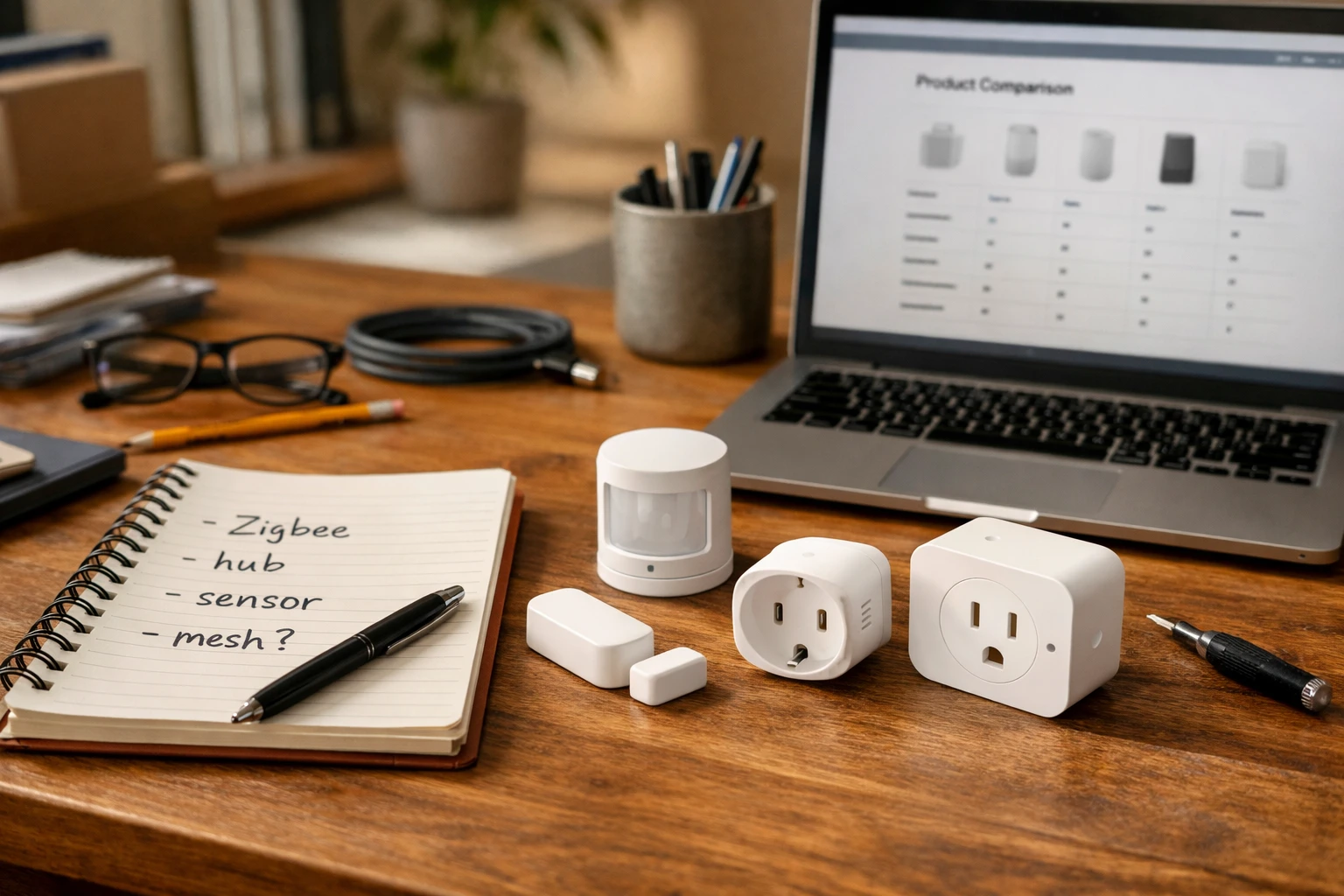
Zigbee may sound like just another smart home buzzword, but it is one of the technologies that can make or break a DIY setup. This article explains what Zigbee is, how it works, and why understanding it can help you make smarter choices before buying your first sensors and devices.
Introducing Zigbee
In my previous article, Learn The Language of Smart Home, I tried to make smart home technology a little less confusing by translating some of the words and concepts that tend to show up the second you start looking into home automation.
That article was really about one thing: getting far enough into the language that you do not immediately feel like you have walked into a room where everyone else got the manual except you.
And that is exactly where Zigbee comes in.
Because when I started researching my own DIY alarm project, I did what most people do. I opened Google. I watched YouTube videos. Mostly the kind that love showing sensors, cameras, hubs, and shiny little gadgets with names that somehow all sound both clever and slightly suspicious. I browsed Amazon. I walked through electronics stores and even a few hardware stores that sell DIY alarm kits.
Yes, physical stores still exist. Apparently, not everything has become an affiliate link yet.
At first, I thought the job was to compare products. Which sensor looked best. Which camera seemed smartest. Which package gave me the most for the money.
But fairly quickly, it became obvious that this was not really about products at all.
It was about understanding just enough of the technology underneath them to avoid building a project on bad assumptions, poor compatibility, and the kind of shopping decisions that end with a box of expensive electronics no longer on speaking terms with each other.
And if WAF was already going to be under pressure because I wanted to build our own alarm system, then “I bought the wrong ecosystem and now half of it doesn’t work” was not exactly going to help.
So somewhere in the middle of all that searching, comparing, and trying not to fool myself into buying first and understanding later, I realized that I needed to learn a little more about the rules that make smart home devices work together.
One of those rules is Zigbee.
What Zigbee Actually Is
Zigbee is a wireless communication protocol used in smart home systems and other IoT setups to connect smaller devices like sensors, switches, bulbs, and controllers.
If that sounds a bit dry, here is the useful version:
Zigbee is one of the technologies that helps your devices talk to each other in a structured, stable, and relatively power-efficient way.
The name is inspired by the way honeybees communicate through movement, and while that may sound like branding people having a good day at work, it is actually a decent metaphor. Zigbee is built for lots of small devices exchanging short pieces of information efficiently rather than one big dramatic performance.
That matters because most smart home devices do not need to stream movies or handle giant amounts of data.
A door sensor just needs to say something like: “The door opened.”
A motion sensor says: “Something moved.”
A thermostat says: “It is colder than expected.”
That is not a lot of data. But it is very important that the message gets through reliably, and preferably without draining a battery every other month.
That is exactly the kind of job Zigbee was designed for.
Technically, Zigbee is based on the IEEE 802.15.4 standard. You do not need to remember that unless you enjoy collecting numbers that make dinner conversations awkward. What matters more is that Zigbee was designed for low power consumption, modest data rates, and many devices in the same network.
So while Wi-Fi is fast and Bluetooth is familiar, Zigbee was built with a different purpose in mind.
It is not trying to be impressive.
It is trying to be useful.
Why Zigbee Exists in the First Place
Zigbee did not appear because engineers felt there were not enough wireless standards in the world. It was created because existing options were not a great fit for small, battery-powered devices.
Wi-Fi is powerful and fast, but it uses more power than you want in a small sensor sitting quietly on a window frame for years.
Bluetooth uses less power, but historically it has not always been the ideal choice for larger, distributed smart home setups where range and network structure matter more.
Zigbee was built as a compromise that made a lot of sense for automation:
- lower data speed
- lower power consumption
- more stable communication for small messages
- support for many devices in one network
That tradeoff is the whole point.
In a smart home, “fast” is often much less important than “reliable” and “does not kill the battery.”
If a security sensor reacts correctly every time and survives for years on a battery, most people will happily accept that it is not winning any speed tests.
And this is exactly why Zigbee shows up so often in smart lighting, sensors, thermostats, and alarm-related components. It is well suited to devices that need to be present, dependable, and boring in the best possible way.
How a Zigbee Network Works Without Turning This Into Engineering Class
This is the slightly nerdier part, but it is also where Zigbee starts becoming genuinely useful to understand.
A Zigbee network usually consists of three types of devices:
The Coordinator is the device that creates and manages the Zigbee network.
In practice, this is often a hub, gateway, or controller. It is the thing that says, “This is the network, and these are the rules.”
You only need one coordinator in a Zigbee network.
The Router helps pass signals along between devices.
This is one of the reasons Zigbee can be so useful in a home. Certain mains-powered devices, such as smart plugs or wired-in components, can help extend the network by forwarding messages from one device to another.
End Devices are the devices at the edges of the network, often battery-powered ones like motion sensors, door sensors, temperature sensors, and similar gadgets.
They usually do not forward traffic for other devices. They just do their own job and conserve power.
This is where the term mesh network becomes important.
A Zigbee network is not always dependent on a single direct connection between one sensor and one central box. Devices can often communicate through other compatible devices in the network. If one path is weak or blocked, the system may find another route.
That gives Zigbee one of its biggest strengths: the network can become more robust as it grows, especially when you add powered devices that act as routers.
That is also why Zigbee often works so well in practical home setups. It is not just a collection of isolated gadgets. It can become a network where devices help hold the whole thing together.
For something like a DIY alarm system, that is not a minor detail.
It is the difference between “my sensor usually works” and “my sensor is part of a structure designed to keep working.”
Why Zigbee Makes Sense in Real DIY Projects
This is where theory becomes buying decisions.
Zigbee is especially useful in projects involving:
- door and window sensors
- motion sensors
- temperature and humidity sensors
- smart lighting
- buttons and switches
- thermostats
- other automation devices that send small updates rather than large data streams
That makes it highly relevant for anyone building a practical smart home setup piece by piece.
And it also explains why Zigbee kept showing up when I researched my own alarm project. Once you start looking seriously at sensors and automation, you quickly realize that the question is not just what the device does.
It is also:
How does it communicate?
How long will it run?
Will it play nicely with the rest of the system?
Will I need a hub?
Will I be able to expand later without rebuilding everything from scratch?
Zigbee tends to score well on exactly those questions.
Its low power use makes it ideal for battery-powered devices.
Its mesh structure can improve stability across the home.
Its broad use in smart home products means there are many devices built around it.
But Zigbee is not magic, and this is where it helps to know just a little more.
Most Zigbee devices operate in the 2.4 GHz band, which is the same frequency area used by Wi-Fi and Bluetooth. That does not mean Zigbee and Wi-Fi automatically go to war the moment they meet, but it does mean interference can happen if things are poorly placed or poorly configured.
This is one of those small technical details that can save you frustration later. Because sometimes “this system feels unreliable” is not a mysterious curse. Sometimes it is just wireless traffic stepping on itself.
So yes, Zigbee is user-friendly in many ways, but it still helps to understand the basics of how and where it operates.
And that is really the pattern here:
you do not need a networking degree, but you do need enough understanding to make smarter choices.
Zigbee in Context: Wi-Fi, Bluetooth, Z-Wave, Matter, and the Real World
It is worth briefly placing Zigbee in the larger smart home picture, because most readers will not be choosing in a vacuum.
Wi-Fi is great for devices that need higher bandwidth or already fit naturally into your home network, but it often uses more power than you want for small sensors.
Bluetooth can be useful for short-range communication and setup, but it is not always the first thing people build a larger home automation system around.
Z-Wave is often seen as Zigbee’s closest cousin in the smart home world. It was also designed for low-power home automation, and it has its own strengths, including operation in a different frequency range that can sometimes help avoid the congestion found in 2.4 GHz environments. For some readers, Z-Wave may absolutely be the road they choose instead.
Matter is the newer big conversation in smart home technology because it aims to make devices across platforms work together more easily. Matter does not erase Zigbee overnight, though. In practice, Zigbee remains very relevant because so many existing products and installations already rely on it. In many homes, Zigbee will continue to live on through hubs, bridges, and gateways even as newer standards grow around it.
And then there is the professional alarm world.
Not every alarm system is built on common smart home protocols like Zigbee or Z-Wave. Some professional systems use their own more closed communication methods and ecosystems. That can offer simplicity from a user perspective, but it can also mean less flexibility, fewer integration options, and more dependence on one vendor.
That does not automatically make one model better than the other.
It just means the choice is not only about features. It is also about philosophy.
Do you want a more closed system that largely takes care of itself?
Or do you want a more flexible setup where learning a little gives you more control?
That is a very FamCTO kind of question, really.
What You Learned About Zigbee
If you have read this far, then the good news is that you do not need to become a protocol specialist before moving on with your project.
You just need to know enough to choose wisely.
And the important things to understand about Zigbee are actually quite manageable:
- Zigbee is built for small smart home devices that send limited amounts of data
- it is designed for low power consumption, which is why battery-driven sensors often use it
- it can form a mesh network, which helps make communication more stable
- it is widely used in smart home devices, especially sensors, switches, and lighting
- it may require a hub or gateway, depending on the ecosystem you choose
- it can coexist with other technologies, but placement and compatibility still matter
That is enough to move forward intelligently.
Enough to look at a sensor and ask better questions.
Enough to understand why one setup may be smarter than another.
Enough to reduce the risk of filling a drawer with the technological equivalent of regret.
And that, honestly, is the whole spirit of Learn a little, plan a little, start small.
Because the goal is not to understand everything before you begin.
The goal is to understand enough that your next step is a good one.
2 responses to “Zigbee Demystified”
[…] my article Zigbee Demystified, I wrote about that slightly awkward feeling smart home research gives you in the beginning: the […]
[…] standards and protocols matter. Matter, Zigbee, and Z-Wave all exist to improve interoperability and help smart devices work together across […]